
Product Overview
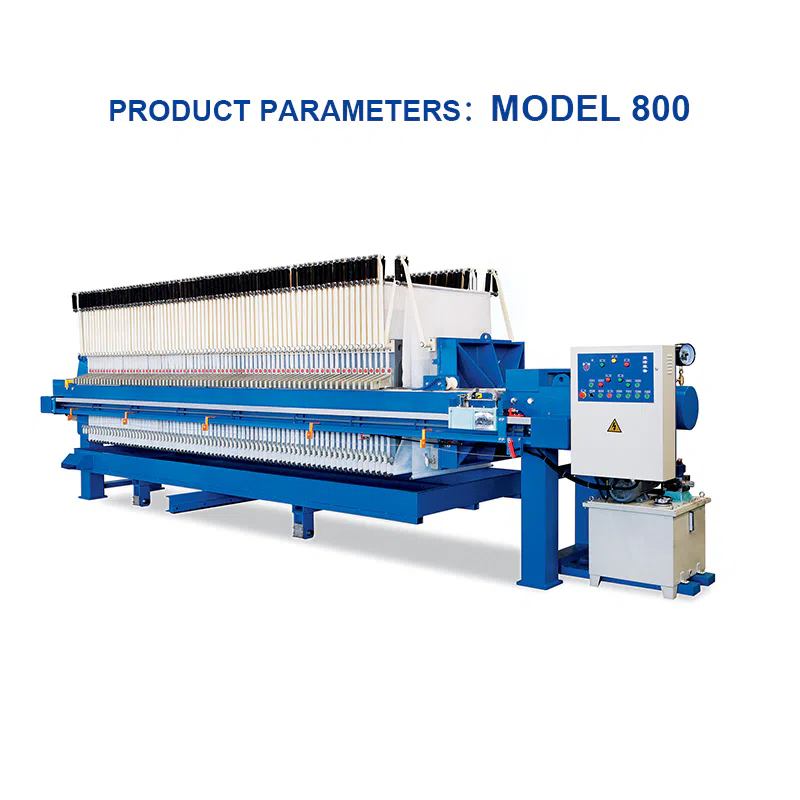
The 800 Cloth-Shaking Filter Press is intended for solid-liquid separation duties where sticky filter cakes resist release from the cloth after filtration. It combines programmable plate shifting with a cloth-flexing discharge mechanism, focusing on what happens after the plate pack opens rather than changing the filtration medium itself.
During cake discharge, the mechanism alters the cloth angle to form a V shape. Springs attached to the cloth extend and contract, creating movement that helps loosen material adhering to the filtration surface. This action is coordinated with the automatic plate opening sequence to reduce repeated manual intervention where cakes are difficult to release.
The 800 designation is part of a product family that also includes 1000, 1250, 1500 and 1600 models. Membrane squeezing, liquid collection equipment, and sludge handling systems may be considered where the process requires them. The filtration area, actual plate dimensions, and operating parameters for this particular model must be confirmed separately.
Technical Information
| Item | Description |
| Model | 800 |
| Available Series Models | 800, 1000, 1250, 1500, 1600 |
| Discharge Mechanism | Cloth-flexing arms, V-shaped cloth movement, and spring-assisted shaking |
| Plate Opening | Programmable Automatic Plate Shifting |
| Typical Flexing-Arm Material | ABS (subject to final configuration) |
Cloth-Flexing Discharge Principle
Plate Opening After filtration, the programmed plate shifting system opens the plates for cake discharge.
Change in Cloth Geometry The flexing mechanism alters the cloth inclination and creates a V-shaped profile at the discharge position.
Spring Movement Springs connected to the cloth extend and contract, helping disturb cakes that adhere to the fabric.
Cake Release The combined mechanical action promotes release, although the result still depends on the properties of the processed material.
Applications
Fine Chemicals and Pharmaceutical Intermediates
Suitable for evaluating separation duties in which cakes adhere to the cloth and do not readily discharge.
Industrial Wastewater Treatment
Can be considered for wastewater filtration operations where cake release is an operational concern.
Sugar, Starch, and Textile Processing
For relevant sticky-cake duties, the cloth-flexing discharge mechanism can be assessed as part of equipment selection.
Selection Checklist
Cake Release Behavior Describe cake formation, cloth adhesion, and current manual discharge requirements to support suitability assessment.
Equipment Sizing Confirm the specific 800 configuration against required filtration area, plate specification, and automation scope.
Optional Systems Specify any need for membrane squeezing, liquid collection trays or flaps, and sludge conveying or storage during project review.


