Product Overview
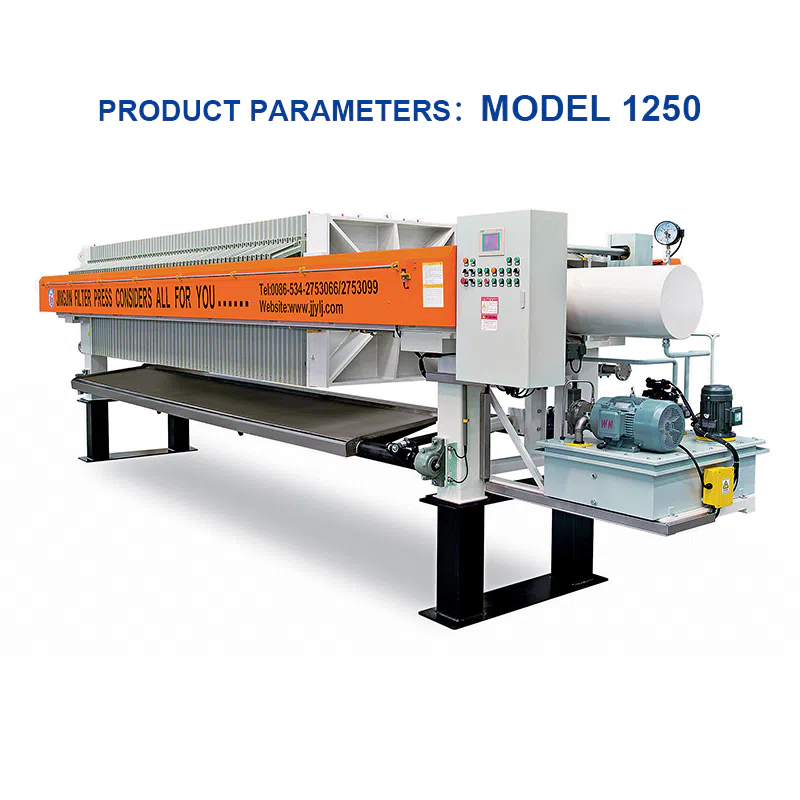
The 1250 Programmable Filter Press is a batch-operated pressure filtration machine intended for a wide range of industrial slurry separation duties. Its integrated mechanical, electrical, and hydraulic arrangement coordinates clamping, filtration, release, and automatic plate shifting according to a programmed operating sequence.
Industrial feeds differ in particle size, solids concentration, viscosity, and cake behavior, so the selected filter press must reflect the actual filtration duty. For materials that tend to adhere to the cloth, a cake shaking unit may be considered. Tilting drip trays may be specified where liquid collection is important, while automatic cloth washing can support operations requiring periodic filter medium maintenance.
The 1250 model uses PLC and touchscreen-based control for the relevant operating functions, with manual and automatic modes available. Variable-frequency drives are commonly used for plate shifting within the series, but the actual drive arrangement, remote interface, and auxiliary systems depend on the equipment specification.
The model designation does not establish a unique filtration area, chamber quantity, or hourly throughput. Technical selection should therefore consider material testing, filtration targets, and the installation requirements of chemical, mineral processing, and sludge dewatering projects.
Operating Conditions
1. Feed Solids and Flow Behavior
Solids concentration and flow characteristics influence filtration cycles and feed arrangements; representative test results should inform selection.
2. Cake Formation and Release
Cake thickness, adhesion, and discharge behavior should be reviewed when considering an auxiliary shaking mechanism.
3. Filtrate Collection
The need for tilting drip trays depends on how the plant must collect filtrate and manage liquid dripping.
4. Cloth Maintenance
Feeds associated with significant cloth fouling may justify evaluating an automatic washing unit.
Modular Expansion
The 1250 model can incorporate auxiliary modules when required, but cake shaking, tilting drip trays, and automatic cloth washing are not assumed to be standard on every unit. Each module should have a defined process purpose and a confirmed operating relationship with the main press.
Engineering review should address mounting positions, drive arrangements, control sequences, and maintenance access. If the unit must communicate with feed pumps, downstream conveyors, or a plant control system, the relevant interfaces and operating responsibilities should be specified.
Applications
1. Chemicals and Metallurgy
Applicable to selected chemical and metallurgical slurries, subject to review of material compatibility, particle characteristics, and filtration requirements.
2. Mineral Processing
Can be evaluated for concentrate or tailings filtration where representative testing confirms suitability.
3. Industrial Sludge Dewatering
Relevant to selected industrial wastewater sludge duties where cake formation and discharge behavior are important.
4. Other Industrial Duties
Food and pharmaceutical duties require separate verification of wetted materials, hygiene design, and applicable compliance requirements.
Project Selection
1. Establish Feed Data
Provide solids content, particle characteristics, viscosity, and any relevant chemical compatibility information.
2. Set Filtration Targets
Define the required processing duty, target cake condition, and filtrate requirements, and verify the filtration area against test results.
3. Define Automation Scope
Confirm the included monitoring, alarms, plate shifting drive, and optional auxiliary functions rather than assuming the same equipment package for every unit.
4. Verify Site Integration
Review foundations, installation dimensions, service clearance, and upstream/downstream interfaces.


