
Product Overview
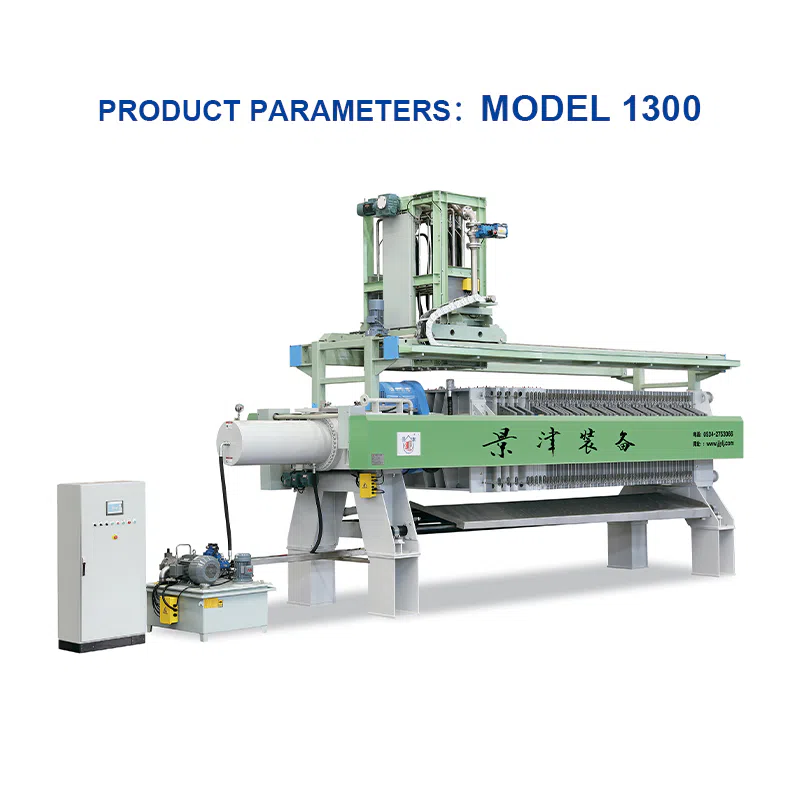
Filter Press for ETP Plant, Model 1300, is an automatic-locking press for solid-liquid separation in titanium dioxide production wastewater and coal washing applications. Its filtration area ranges from 100–220 m². The filter assembly retains solids as liquid leaves the press, and the resulting cake can undergo further squeezing. The dewatering result depends on the material and operating conditions.
The equipment combines a frame, filter assembly, hydraulic system, discharge device, automatic locking device and electrical controls. These parts carry the load, separate the slurry, apply clamping, handle discharge, secure the locking position and control movements around the plate pack. A geared motor drives the locking nut forwards and backwards.
The nut limits piston-rod retraction under filtration reaction loads or a drop in cylinder pressure. This helps maintain the clamped condition and reduces the associated risk of plate damage and slurry splashing. Mechanical locking holds the position; filtration and cake squeezing perform the dewatering.
Within the plant, the 1300 press connects upstream slurry handling with downstream solid and liquid reception. Once the area is selected, feed properties, cake compression and operating conditions define the process arrangement, allowing mechanical retention and dewatering to serve their distinct roles.
Equipment Structure
Frame and filter assembly
The frame carries the filtering components and transmits operating loads. The filter assembly retains solids and provides the liquid discharge path. Its mounting and loading are linked to the frame and clamping assembly.
Hydraulics and automatic locking
The hydraulic system performs the movements associated with clamping and releasing the press. The automatic locking device holds the corresponding locking position through the nut. The two systems work together, with separate duties in actuation and mechanical locking.
Discharge and electrical controls
The discharge device handles the separated cake. Electrical controls organize the mechanisms so that locking, release and discharge are coordinated with press operation.
These relationships continue through daily use: the frame supports the filtration assembly, filtration proceeds with the pack clamped, the nut restrains unwanted movement, and the discharge device handles the separated solids. The complete arrangement also accounts for working space and the direction in which material enters and leaves.
Locking and Pressure Functions
Clamping and locking
The plate pack needs to remain closed while the press operates. Reaction loads during filtration and changes in cylinder pressure can affect that condition. Once the locking nut is in position, it limits the associated piston-rod retraction.
Motor movement and load restraint
The geared motor moves the nut forwards or backwards to change its working position. The nut then performs the mechanical locking duty. Motor actuation, cylinder movement and restraint after locking have distinct functions.
Cake squeezing
Squeezing acts on liquid remaining in the cake, while the closing system retains the plate pack. Specifying their working requirements separately brings the filtration assembly, hydraulics and locking nut together according to their respective functions, supporting dewatering and the subsequent discharge stage.
During filtration, liquid leaves the filtration area while solids remain. The locking nut adds mechanical restraint to piston rod retention, reducing the risk of backward movement associated with changing hydraulic conditions. Observation of nut travel and plate pack condition can be included alongside routine hydraulic checks.
Process Applications
Titanium dioxide production wastewater
The press serves the relevant wastewater solids-separation stage. Define the feed composition, solids-separation objective and destination of the filtrate so the task fits the production process.
Coal washing
The equipment is used for filtration and cake squeezing of coal washing materials. Feed particles, solids content and subsequent cake handling define the required separation result.
Changing conditions
Both applications are configured around the actual feed, with changes in material linked to the corresponding filtration results. When production conditions change, the medium, operating schedule and cake reception arrangements can be reviewed together to keep equipment use aligned with the process objective.
Application planning includes the destinations of both filtrate and cake. Liquid reception defines the discharge connection, while cake condition influences unloading and handling arrangements. Combining these requirements with material trial results places the press within a clearly defined production stage.
Frequently Asked Questions
Does Model 1300 define the throughput
1300 is a model designation. Throughput also depends on feed solids content, particle properties, the filtration process and the required cake condition, and must be established for the material.
What remains to be specified after choosing the filtration area
Define cake-squeezing requirements, the plate-pack configuration and the discharge arrangement. For replacement equipment, also describe the operating issue to be resolved. Filtration area is one part of the equipment specification.
Does automatic locking include every auxiliary function
Automatic locking covers the motor-driven forward and reverse nut movement and its locking function. The operating method and supply scope of other mechanisms should be listed individually in the selected configuration.
Which operating targets should a project trial address?
Specify the receiving requirement for cake, the downstream filtrate route and planned operating hours together. Trials with representative slurry connect filtration, squeezing and discharge performance, providing a basis for the process conditions and supporting specifications.


